
Last week I helped a friend think through several solar and battery options for his property.
On the surface, the question seemed fairly straightforward. Which proposal made the most sense? Which company should he trust? Did the battery make financial sense? How much backup power did he actually need? What would happen in five or ten years if something stopped working?
Those are all reasonable questions. But as we talked, I found myself asking a slightly different one.
How do we help people make better judgments without taking over their decisions?
That question has been sitting with me for a while. I have written twice before about helping people in need. The first time was after the Sunworks bankruptcy left many solar owners in California without the long-term support they thought they had purchased. The second time was after seeing people work together in moments of fire, grief, and uncertainty. In both cases, the need was real. But the need was not always as simple as it first appeared.
When my friend asked for help, I could have simply given him my opinion after reviewing the proposals. I know enough about solar, batteries, monitoring, warranties, maintenance, and the strange little traps that appear when humans combine electricity, contracts, and optimism. But I did not want him to depend only on my judgment, particularly because I had connections with some of the vendors.
He was the one who had to live with the decision. He was the one who would own the system, pay for it, maintain it, and find out years later whether the decision had been wise. So I created what I have started calling a judgment seed.
A seed is really just a structured prompt that carries context into a conversation with AI or another advisor. It names the situation, the constraints, the risks, the knowns, the unknowns, and the questions that should not be skipped. The point is not to let AI make the decision. That would be a terrible idea, just formatted very confidently. The point is to help someone think more clearly before they are rushed, confused, sold, or overwhelmed.
In my friend’s case, the seed helped frame the decision around what actually needed protection. Was he trying to protect his money? Was he trying to protect himself from outages? Was he trying to protect future flexibility? Was he trying to avoid being locked into a system that sounded impressive but did not fit his actual needs? Was he trying to protect his ability to maintain the system years from now?
Those are different questions. They lead to different answers. A battery can be a wise investment in one situation and an expensive distraction in another. The same equipment can be helpful or unhelpful depending on what you are actually trying to protect.
That is where I think helping people becomes harder than it first appears. If we answer the visible question too quickly, we may help someone solve the wrong problem.
I’ve also been thinking again about solar asset owners in California whose EPC or installer has collapsed. Many of these owners did what they were supposed to do. They hired a reputable company. They invested significant money. They expected a long-term asset. They may have been promised support for many years.
Then suddenly the company was gone, like Sunworks was just over two years ago when we first started helping owners in California.
At first, their need may appear obvious. They need someone else to fix or maintain their solar system. And yes, sometimes that is exactly what they need. But underneath that, there is often something more fragile.
They need to recover visibility into what they own. They need to know if the system is actually working. They need to understand whether hidden losses have already accumulated. They need to know who they can trust. They need to avoid being sold another solution before they understand their current reality. They need to protect the long-term value of an asset they already paid for, not just apply a temporary patch.
That is not just a technical problem. It is a fog problem where seeing clearly can be difficult.
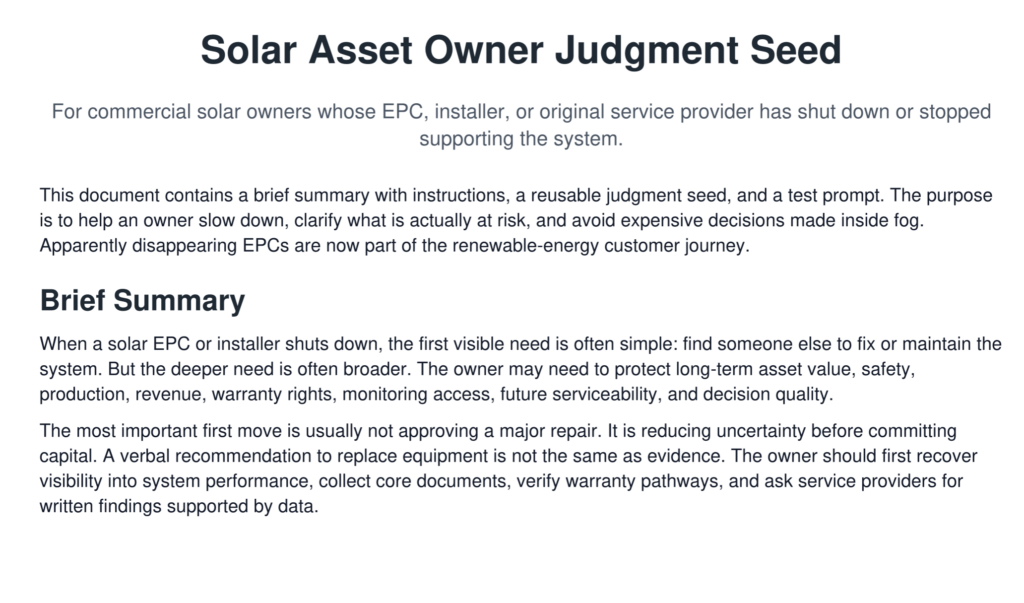
So I decided to create and share a judgment seed for solar asset owners whose EPC or installer has shut down. It is not a substitute for qualified technical, legal, financial, or safety advice. It will not magically diagnose a failed inverter, recover a warranty, or make a monitoring portal less confusing. If AI could do all that, I would be more worried than impressed.
But it may help an owner slow down. It may help them gather the right documents, ask better questions before approving expensive repairs, distinguish a contractor’s verbal guess from a written diagnosis, and understand that restoring monitoring access is not the same as restoring oversight.
It may help them protect what matters before spending money in the fog.
I’ve experimented with creating seeds like this for different purposes and different contexts because I’ve been taking this approach myself to help make better decisions. They are a way of sharing how to judge without taking over the decision. A good seed does not say, “Trust me.” It says, “Here is a way to think through this more clearly.”
A solar owner whose EPC has disappeared may not know whether the system is producing properly. A newcomer looking for work may not know how to translate their experience into a new country’s employment system. A friend evaluating battery options may not know whether the sales proposal is protecting their needs or someone else’s margin. An employee growing into a new role may not need someone to do the work for them, but may need help seeing the next right step. These are all examples of seeds I’ve created to try to help people in need.
I am still learning this myself. My natural instinct is often to quickly solve the problem I can see based on my experience and judgement. Sometimes that is useful. Sometimes it is just me reacting too quickly to the visible part of the need.
So I am sharing the solar asset owner seed as an experiment. Maybe it helps someone whose installer has disappeared. Maybe it helps someone ask a better question before they spend money. Maybe it helps a contractor, advisor, or owner slow down enough to separate evidence from assumptions.
Helping people in need is not always about giving them an answer. Sometimes it is about helping them see a little more clearly so they can make their own decision with less fog, less pressure, and a little more confidence.
If this potentially helps one person in need, then this seed has served its purpose.